


Rob D
-
Posts
6,098 -
Joined
-
Last visited
-
Days Won
3
Content Type
Profiles
Forums
Classifieds
Tip Site Directory
Blogs
Articles
News
Arborist Reviews
Arbtalk Knot Guide
Gallery
Store
Freelancers directory
Everything posted by Rob D
-
Double ended chainsaw milling - What is it? Chainsaw milling usually involves using x1 powerhead. Double ended milling means you are running a chainsaw at each end. Favourite question? Surely the chainsaws have to run at the same rpm or else one will be running the other. A resounding ‘no’ is the answer! Say you have an MS880 and when you rev the ‘nuts’ off it unloaded it is running at 12,000rpm. Say you have another MS880 and you rev the nuts off that and it’s rev count is 12,500rpm. If you hitched these up to a double ended bar and ran them both full tilt out of the wood then one saw probably would be driving the other to a certain extent. But that’s the point – when do you rev saws that high for any period without cutting? You don’t! Both saws revs will drop right down as you introduce it into the wood – both saws say may now be revving at 8,000rpm – both are trying to push that chain around the bar. Second favourite question? Do you need to use the same saws? Again a resounding ‘no’! The combos I’ve used (and have worked really well each time) as follows: MS260 and MS440 on a 50” double ended bar running 3/8 .063 chain Makita 9010 and Makita 9010 on a 60” double ended bar running .404 .063 chain MS880 and MS660 on a 72” double ended bar running .404 .063 chain 395XP and 372XP on a 72” double ended bar running .404 .063 066 and 088 on an 87” double ended bar running .404 .063 MS660 and 390XP on 72” double ended bar running .404 .063 Which manufacturer’s chains used in the above – can’t remember! But various and all worked fine. Speed? How much faster? If done correctly you mill around x3 times the speed as with a single powerhead. Not actually measured this but that’s what it feels like. Power at both ends and oil at both ends makes a huge difference in keeping chain speed up and pulling the saw dust out of the cut. No need to buy an MS880 as x2 medium size saws will do it. So if it’s all so brilliant why isn’t everyone doing it? Set up is very awkward indeed. .404 chain is the strongest so that’s the best to use which may mean changing the drive rim over. Fine on outboard clutches but a pain in the backside on inboard clutches. With such long bars trying to fit the saws each end with one being back to front can be fiddly and time consuming. You will also likely need bar spacers on saws 90cc and smaller. Not everyone has access x2 saws to do it with! If one saw won’t start then can be frustrating. Starting the cut is more awkward than a single powerhead and especially so when using the log as a reference (not a ladder or first cut system). Chain slackens regularly and easily. To start with cutting can be uneven and it’s harder to get flat even cuts using a double mill. Takes x2 people instead of x1. You need someone who knows what they are doing on the far end. They control the speed of cut. Communication is tricky between both millers – you need to have a feel of how the other person works Lead saw gets pulled hard up to log. Going ‘up’ and around a bump is fine. Coming off the other side of said bump all that power means the mill really jumps around it and causes the chain to bog down (see further below – running a straight edge down the log for lead saw). You can almost be caught in a groundhog moment pulling the saw back and then it jumps forward and bogs down again. With a single powerhead you can hold it back but with a double ended set up you can’t! Poor set up and inexperience operation can mean the bar flexes up or down in the cut. Allowing the saws to rev themselves too high can only lead to piston scoring and a large bill. An inexperience person on the end of the log could easily cause this. Temptation is to go the whole way down the log without resting the saws – another way to overheat them. There are some pretty awful videos of people chainsaw milling on youtube so be careful what you watch and read. Some of the blunt chains used mean that no matter how much power you have the results are painful to watch. Here’s a few of myself running different set ups - Husky 395XP and 372XP (the chain tensioner position on the 395XP makes it harder to adjust chain tension but it is still possible) Stihl MS660 and Husky 390XP Stihl 088 and Stihl 066 Not a bad video here, but would be good to have a method of siting the mill so power heads are the same distance off the log. View full article
-
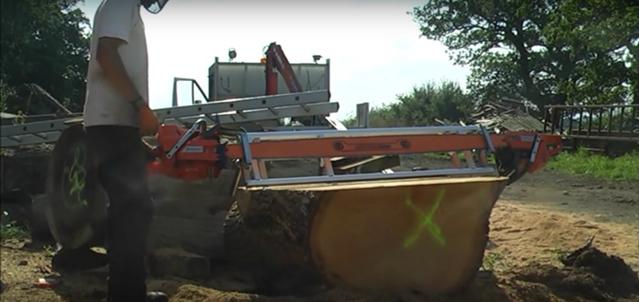 Double ended chainsaw milling - What is it? Chainsaw milling usually involves using x1 powerhead. Double ended milling means you are running a chainsaw at each end. Favourite question? Surely the chainsaws have to run at the same rpm or else one will be running the other. A resounding ‘no’ is the answer! Say you have an MS880 and when you rev the ‘nuts’ off it unloaded it is running at 12,000rpm. Say you have another MS880 and you rev the nuts off that and it’s rev count is 12,500rpm. If you hitched these up to a double ended bar and ran them both full tilt out of the wood then one saw probably would be driving the other to a certain extent. But that’s the point – when do you rev saws that high for any period without cutting? You don’t! Both saws revs will drop right down as you introduce it into the wood – both saws say may now be revving at 8,000rpm – both are trying to push that chain around the bar. Second favourite question? Do you need to use the same saws? Again a resounding ‘no’! The combos I’ve used (and have worked really well each time) as follows: MS260 and MS440 on a 50” double ended bar running 3/8 .063 chain Makita 9010 and Makita 9010 on a 60” double ended bar running .404 .063 chain MS880 and MS660 on a 72” double ended bar running .404 .063 chain 395XP and 372XP on a 72” double ended bar running .404 .063 066 and 088 on an 87” double ended bar running .404 .063 MS660 and 390XP on 72” double ended bar running .404 .063 Which manufacturer’s chains used in the above – can’t remember! But various and all worked fine. Speed? How much faster? If done correctly you mill around x3 times the speed as with a single powerhead. Not actually measured this but that’s what it feels like. Power at both ends and oil at both ends makes a huge difference in keeping chain speed up and pulling the saw dust out of the cut. No need to buy an MS880 as x2 medium size saws will do it. So if it’s all so brilliant why isn’t everyone doing it? Set up is very awkward indeed. .404 chain is the strongest so that’s the best to use which may mean changing the drive rim over. Fine on outboard clutches but a pain in the backside on inboard clutches. With such long bars trying to fit the saws each end with one being back to front can be fiddly and time consuming. You will also likely need bar spacers on saws 90cc and smaller. Not everyone has access x2 saws to do it with! If one saw won’t start then can be frustrating. Starting the cut is more awkward than a single powerhead and especially so when using the log as a reference (not a ladder or first cut system). Chain slackens regularly and easily. To start with cutting can be uneven and it’s harder to get flat even cuts using a double mill. Takes x2 people instead of x1. You need someone who knows what they are doing on the far end. They control the speed of cut. Communication is tricky between both millers – you need to have a feel of how the other person works Lead saw gets pulled hard up to log. Going ‘up’ and around a bump is fine. Coming off the other side of said bump all that power means the mill really jumps around it and causes the chain to bog down (see further below – running a straight edge down the log for lead saw). You can almost be caught in a groundhog moment pulling the saw back and then it jumps forward and bogs down again. With a single powerhead you can hold it back but with a double ended set up you can’t! Poor set up and inexperience operation can mean the bar flexes up or down in the cut. Allowing the saws to rev themselves too high can only lead to piston scoring and a large bill. An inexperience person on the end of the log could easily cause this. Temptation is to go the whole way down the log without resting the saws – another way to overheat them. There are some pretty awful videos of people chainsaw milling on youtube so be careful what you watch and read. Some of the blunt chains used mean that no matter how much power you have the results are painful to watch. Here’s a few of myself running different set ups - Husky 395XP and 372XP (the chain tensioner position on the 395XP makes it harder to adjust chain tension but it is still possible) Stihl MS660 and Husky 390XP Stihl 088 and Stihl 066 Not a bad video here, but would be good to have a method of siting the mill so power heads are the same distance off the log.
 -
Good work - and good pics!
-
I hate those threads where folk give virtually no details to allow others to answer them Break it down some! What saws you got? What mills you got? What experience do you have? Where are you based? All of that has a bearing on what price you can charge.
-
Oh welcome to the forum by the way
-
We looked at importing them when they came out - too expensive for what they are IMHO. Used to own a Peterson WPF - superb machine for what it could do - max cut was 8" and the engine had to work to cut that: this had a Honda twin 27HP engine 090 has 13HP I believe MS880 has 8.6HP and most will be using with an MS880 So a third of the power that the large Peterson have to do the same cut. Not saying that it doesn't do the job - it does - but the price compared with functionality will mean it will never sell in high numbers (again IMO).
-

SDS Drill vs standard cordless for drilling wood gateposts
Rob D replied to Matthew Storrs's topic in General chat
Haha! Yep but it's irrelevant whether you need one or not - it's just if you want one or not -
SDS Drill vs standard cordless for drilling wood gateposts
Rob D replied to Matthew Storrs's topic in General chat
We will soon be looking to import some of these drills which attach to your saw... Should have one to play with towards the end of next week - slight issue is you need a wide range to fit different saws... May well do a pre order style offer where you tell me your saw and we'll order that one in - you'll wait 6-8 weeks but you'll get a better price. PM me if interested. -
I reckons you could be right!
-
We now have a new quick release style system for the new Granberg brackets. Operates on a clamp handle one side and thumb nut the other. Crude video here - we had to get our own U bolts made so they were a metric thread.
-
Yep your bar is fine - I tend to be around 2" from the nose sprocket as a rule of thumb but check to see if the nose sprocket gets hot. Correctly sharpened chain is the key and most important aspect of milling (and all chainsaw work really).
-
You can't clamp on or near the nose - or good chance you'll knacker the sprocket. With regards setting up and milling it's a big topic - do your research on here. We have loads of vids here as well Videos - Alaskan Mill ? Mobile Chainsaw Mills
-
Ok Ed no worrys if there are any issues in the future let me know
-
What exactly are 'arb arisings?'
-
Good Size logs needed for Confor Show Longleat 7th/8th Sept
Rob D replied to Rob D's topic in Panther Mill UK
Thanks actually already got a PM so seems this is now sorted -
Not got any spares yet but I think the blades used are pretty standard ie used in other planer type tools... will check up on this.
-
We'll be doing the Confor Show at Longleat, Warminster this year on the 7th/8th September. We'll be demoing mills and so forth so need some good size logs to mill - around 30" to 36" works well or larger. Usually we make some tables on site as we demo so if you have some wood you want turned into slabs or tables then you may be interested (tend to go halves with you on these) For example you bring a 3 foot diameter log 6 foot long - we make say x4 tables and a few odd slabs - you get x2 tables and the odd slabs and we keep x2 tables. Doesn't have to work exactly as above but along those lines! Cedar and Oak works well but open to what you have. What you got?
-
I'm on it and don't really use it for marketing or otherwise.... But I would imagine if you were pro active you could get more business by chatting to potential advertisers etc. But with facebook, twitter, instagram, Linked In... all starts to get a bit much IMO. I suppose you have to do it these days if you want to stay ahead of the game.
-
Really? perhaps it seems larger than it is. Bear in mind you don't get the bar or chain just the attachment.
-
They would offer more protection than shorts and flip flops
-
I'd say pretty much the same as the log wizard!
-
Haha! Yep but can't face putting on me chainsaw trousers and boots in this weather! Not got much in the yard to demo on but there will be one coming...
-
We have some of these log de barker tools in stock. They fit directly to the chainsaw bar and then the chain drives the planer blades. Comes with spare rims so you can run 3/8 lo pro or .325 or 3/8 standard sizes chains. Have it here on a 14" bar - shorter bars mean less strain on the wrists (all that weight is on the end of the bar). Used it a few times and seems pretty effective. TTLD Log Debarker Tool - Chainsawbars
-
You can buy syringes (ones for injecting) easily on the net - use these to inject into the exit holes - have done this before with good results. Can't remember what treatment I used though....
-
Cracking!