


Billhook
-
Posts
3,352 -
Joined
-
Last visited
-
Days Won
14
Content Type
Profiles
Forums
Classifieds
Tip Site Directory
Blogs
Articles
News
Arborist Reviews
Arbtalk Knot Guide
Gallery
Store
Freelancers directory
Everything posted by Billhook
-
Because I am not that clever!
-
I have four levels of wood splitting and they all have their place. Wrists are bad now so X27 is in retirement (bit like me) so the little electric kinetic Portek hits above its weight for small jobs in the home. Particularly good for the smaller wood needed for the Aduro 9 stove Before I built the Lockdown Splitter I borrowed this big vertical splitter on the front linkage of the Fastrac Cone splitter on Matbro seemed like a good idea at the time....... Then onto the Lockdown Splitter Lockdown again Daisy Etta Caterpillar D7 was working well until it pushed the static axe out of the ground which was set in a ton of concrete! I just love splitting wood mainly economic but partly therapeutic Still find a place for the useful Portek electric kinetic though,just handy to have near the stove.
-
You’re not my neighbour are you?
-
I actually quite like the little creatures. When I was younger I used to rise early to check our lawn when the moles were working shallow. I found that if I trod carefully and waited eventually I would find one digging at the end of its run. I put my heel behind it and fished it out and put it in my trouser pocket. They don't bite but their claws are powerful, however they were calm in my pocket. (maybe the fumes!) Then it was just a case of taking them a couple of miles away to the fence of an obnoxious bloke in the village who was always causing trouble. I think I released about five in his hedge!
-
Could have been "Moley Onatop!"
-
They must be from Russia as they have left my orchard looking like one of the photos of Eastern Ukraine after a missile attack

-
We have apples like yours, apricots, raspberries, strawberries, no figs though, gooseberries have not checked the Walnuts yet. Everything looks very green, and all the trees seemed to have done well, a bit of Ash dieback but not a lot. Crops on the farm look good but being a farmer I know not to count chickens before they are hatched and there's many a slip twixt cup and lip. As for the greenery I blame CO2, plants like it.
-
Another from the 1980s showing my age ( and Stubby’s)!
-
kronsteen+actor - Recherche Google WWW.GOOGLE.COM
-
Knew I had seen him somewhere before!
-
Not quite a tractor, but nearly and another candidate for the Jubilee celebrations Land Rover Sandringham 6 Rover 3.5 V8 16 speed gearbox, electro hydraulic tipper and crane but 6x6 is not invincible on our heavy clay. Nearly new off road tyres soon became slicks, level ground and not bottomed out Hotspur Cars of Sandringham
-
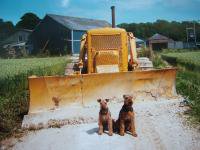
Cat D7 fridge crushing Someone dumped a fridge in one of our fields, the gases had all gone so 20 tons of D7 seemed to be the best option!
-
Little Grey Fergie from 1950 my father bought in 1960. Discovered an important owner in the logbook who bought it secondhand in 1958 but only owned it for a year. Maybe she drove it to take some hay down to the stables?? It appears that because she actually personally owns the Sandringham Estate that her name appears in the logbook. The Royal cars in London May come under another ownership such as the Duchy of wherever The agent who signed the logbook is Major Billy Fellowes who is father of Robert Fellowes who married Princess Diana’ s sister Anyway we decorated her and she was featured at the beacon lighting on Thursday


-
Just a reminder to the World in the current climate
-
Y’all should know ba now that I come from the county of pilgrims, with the towns of Boston, Lincoln, New York. But thank you Slack ma Girdle and Surveyor and for answering that. Never seen one before in spite of hanging around ponds and ditches most of my life!
-
Not quite sure where to post this but this incredibly thin worm was in a completely still stone basin of Spring water. Anyone identify it?
-
 I made this one from scrap in the yard Load it with the Teleporter and the logs take very little effort to move sideways in the boat rollers. Will cope with bent logs quite well
 -
They were very quiet and graceful on cruise power, but like most engines that all changed when you opened her up!
-
Aber vee knew vee had von ze Vor wann Mutti vas put in charge of ze EU!
-
https://www.quora.com/Was-escape-nearly-impossible-for-those-three-crew-members-of-an-Avro-Vulcan-bomber-who-did-not-have-ejection-seats
-
Just remembered that shortly after the crash my cousin came over with his new girlfriend and we went down to the pub where I was full of this new story and started going on about it when my cousin started kicking me under the table and shaking his head. Told me later that his girlfriend's father had been killed failing to eject from a stricken Vulcan. Apparently the three aircrew in the back always had great difficulty in putting on their chutes and exiting via a small door in time and several lives were lost in this way.
-
We used to see the Vulcans regularly on their way from Waddington or Scampton to the range at Wainfleet. I remember the four smoke trails from the RR Avon engines as they hugged the topography of the Lincolnshire Wolds In 1977 the men on the farm saw this Vulcan with flames streaming out above the farm before it crashed three miles away near Spilsby. RAF-lincolnshire.info :: 101 Squadron: Crash of XM600 WWW.RAF-LINCOLNSHIRE.INFO Apparently the pilot parachuted and landed in Halton Holegate and was walking up the road carrying his chute when he met someone who recognised him and in a great example of British understatement said " I expect you could do with a nice cup of tea"
-
Bit more here on the lifeboat Airborne lifeboat - Wikipedia EN.WIKIPEDIA.ORG