

daltontrees
-
Posts
4,941 -
Joined
-
Last visited
-
Days Won
4
Content Type
Profiles
Forums
Classifieds
Tip Site Directory
Blogs
Articles
News
Arborist Reviews
Arbtalk Knot Guide
Gallery
Store
Freelancers directory
Everything posted by daltontrees
-
Me too, and hopefully the Council too and all onlookers whatever their persuasion. Whom would have thought there was so much to interpret in so few words of some (seemingly) obscure legislation? Is it not thus that the will of Parliament is voiced again and again, and that the common man finds solace in his place with power? And vice versa?
-
6 months later and I have finally got round to replying. Attachd is before and after pictures of dried out specimen. I had begun to think that those gills were not gills at all but fibres within the fruiting body. Despite close examination of dried and rehydrateds specimen I could not find anything resembling pores. But revisiting the tree this week kind of answered the question. Last spring there was no evidence of such extensive fruiting having taken place. This year it seems to have gone bonkers. In conclusion the rehydration was not particularly helpful in this case.


-
Sounds like you are heading for a non-acrimonious outcome. Always good news! Regarding valuations, it is entirely possible to carry out a Hwelliwell valuation of a tree as-is and then a valuation of the same tree if it was pruned back. This is because the measurement part of the Helliwell system can easily be adapted to the measurements of a hypothetically pruned tree. A simple example would be this. Tree before pruning has canopy profile area of 120m2, gets 6 Helliwell points. The other factors (life expectancy, importance, other trees, relation to setting and form) come to 30 points. 6 x 30 x £28/point = £5,040. Tree after pruning has a canopy profile area of 90m2, gets 5 Helliwell points. The other factors are the same. New value 5 x 30 x £28 = £4,200. But of course it's not that simple. If the pruning changes the 'form' rating of the tree by one category, its value becomes £2,100. If the pruning only reduced the area to 100m2, there is no change in value because there is no change in area category. These are flaws inherent in the Helliwell system. Using it blindly like a calculator is dangerous.
-
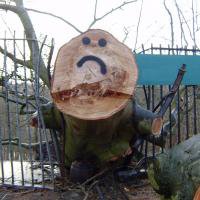
Tis the season to see Fungi, fa la la la la....
daltontrees replied to David Humphries's topic in Fungi Pictures
That's a decent shout, thanks. -
Tis the season to see Fungi, fa la la la la....
daltontrees replied to David Humphries's topic in Fungi Pictures
Could well be one of the Hypholoma, I was hedging my bets because almost everyone of the mushrooms had half a veil (i.e. on one side only) close under the cap. -
Tis the season to see Fungi, fa la la la la....
daltontrees replied to David Humphries's topic in Fungi Pictures
Nearby, these on the remains of what I think must have been Alder.

-
Tis the season to see Fungi, fa la la la la....
daltontrees replied to David Humphries's topic in Fungi Pictures
I am not sure what these are, possibly Armillaria? Host completely hollow and unidentifiable.


-
Tis the season to see Fungi, fa la la la la....
daltontrees replied to David Humphries's topic in Fungi Pictures
This one is my favourite though, I suppose this is geotropism in acvtion. Fomes fomentarius on (unidentifiable) fallen stem, the stem seems to have been in various orientations before coming to its current position. HAs produced a lovely spiral shell-like bracket.

-
Tis the season to see Fungi, fa la la la la....
daltontrees replied to David Humphries's topic in Fungi Pictures
Some pictures from Glen Nevis at the weekend. Amanita muscaria, Piptoporus betulinus and Ganoderma adspersum.


-
It's possible it's Larix decidua 'Pendula'
-
A sensible outcome, your perseverance has been rewarded. I suppose it wasn't the Inspector's job to clarify the law but he seems to be applying the principle of 'necessary' in the right pragmatic way i.e. necessary doesn't mean absolutely no other way of doing it but rather means no practical way. He seems then to have jumped straight to the total removal presumably accepting the evidence that the root-pruned tree would be unviable. Maybe what was useful to your client in the end was that the Council never refuted that, only refuting that there was a practical alternative to pruning.
-
Try Tracey Recycling in Linwood.
-
Major pruning a Horse Chestnut tree
daltontrees replied to Valerie Tomlinson's topic in General chat
Up here in Scotland I have seen a few walnut trees, not a single nut to be seen. Too cold I think. You must be getting a last sniff of the gulf stream or something down there. -
I don't have a list, it's in my head. However, you might find the attached ISA form instructions a good starting point for learners. Presumably I don't need to explain teh difference between VTA and risk assessment, you will be able to work out easily enough which bits apply to the former and not the latter. I know for a fact the form can be downloaded for free but I can't find it just now. ISABasicTreeRiskAssessmentForm_Instructions.pdf
-
Definitely! Although if there are no unusual risks it should be a formality. So much of risk reduction in arb work is achieved by using people who are qualified.
-
It looks like the one in the centre has gills, not pores, which if so rules out Oxyporus. Rules out most of the nastys too, except of course Armillaria, which it could be. The grouping is big enough for Armillaria.
-
Major pruning a Horse Chestnut tree
daltontrees replied to Valerie Tomlinson's topic in General chat
No almost about it, the husks contain all sorts of smelly chemicals including vanilla. They must be irresistible. -
Major pruning a Horse Chestnut tree
daltontrees replied to Valerie Tomlinson's topic in General chat
Sorry, pruning would be pointless, if the tree rats want the nuts they will get them. Unless you make it impossible for them to climb the trunk too. Even then, they can jump a fair distance from tree to tree. I am curious to know whereabouts you are to be getting walnuts, they usually need lots of warmth? -
The best? Doesn't get any better than that. If I was you I'd be more worried then about subbing than when you are in control of your own jobs, unless its a main contractor you know and trust. I do wonder, though, when I did my basic tickets I came out of it aware of the need for risk assessments but I could then have gone sstraight into business and never thought about where the requirement came from and what the law actually says. So at least my previous posting covers that bit, anyone that wants can refer to the Regulations more fully. Ignorance of the law is no defence, but keeping it safe means you will probably never need a defence. Or a hospital.
-
Even self-employed people are affected by the law. Please note that what is important is that no-one is needlessly hurt. So risks should be assessed and eliminated or reduced to an acceptable level. That's not the same as 'doing a risk assessment' and sticking the bit of paper, unseen and undiscussed, in the truck. You do that and it won't protect anybody and won't cover the employer's a*se. Management of Health & Safety at Work Regulations 1999, relevant snippets below 3.—(1) Every employer shall make a suitable and sufficient assessment of— (a)the risks to the health and safety of his employees to which they are exposed whilst they are at work; and ... (2) Every self-employed person shall make a suitable and sufficient assessment of— (a)the risks to his own health and safety to which he is exposed whilst he is at work; and ... (6) Where the employer employs five or more employees, he shall record— (a)the significant findings of the assessment; and . (b)any group of his employees identified by it as being especially at risk.
-
The only common mould i can find for on Viburnum is Botrytis cinerea. Apparently not severe enough to kill quickly. Maybe be to do with the site. I had a customer last year nearly lost a Holly, Cotoneaster and Box. Turned out the site was getting flooded by sopapy water from neighbour's blocked and burst bathroom drain.
-
There can't be many fungi and bacteria that can act quickly and equally effectively to kill conifers AND broadleaves. Even the honey funguses have a couple of species that specialise in one or the other. Yeasty smell suggests a fungus, but it might not be the fungus that killed the trees anad shrubs. Yeast is more like a mould than a mushroom. Could be feeding on dead material.
-
Can any one help with ident of these Bleeding cankers
daltontrees replied to alhazzard25`'s topic in Tree health care
Didn't mean to criticise, just enjoying the speculation and debate, it is how one learns best. Your opinion is singularly the most reliable and rigorous on Arbtalk. But if the OP ever confirms it is an Alnus my money's still on P.alni. based on my own experiences and these few photos. -
Complete wiht screw-on fungal brackets on hitherto unknown hosts, and larch decked out with cedar cones like baubles on christmas trees. That sort of thing? I'll bring a rope and harness...
-
I went for a 3/4 hour run about the campus every morning before conference. Firstly it wasnae me, secondly no hood, thirdly although I was stopping at every labelled tree, I was just trying to breathe, not switching labels. Fourthly, there was NOBODY else around. I would have spotted any label-switchers. But the fun that could have been had, wish I'd brought my pliers.