

.jpg.e9f12a19d04fcc058efbb64b9f640edc.jpg)
Ledburyjosh
-
Posts
380 -
Joined
-
Last visited
Content Type
Profiles
Forums
Classifieds
Tip Site Directory
Blogs
Articles
News
Arborist Reviews
Arbtalk Knot Guide
Gallery
Store
Freelancers directory
Everything posted by Ledburyjosh
-
I have one on my 500i.. Stihl Full Wrap Handles BELLEBROOKARB.CO.UK Stihl Full Wrap Handles For control and handling I asked my stihl dealer to get one initially. They just said they aren't available in the EU. Which is wank to not supply that for one of the best arb saws available when you can readily get one for a 462.
-
Yes and yes, although the hinge quality on most Ash trees particularly the larger ones are unaffected by Ash dieback. Another tree served notice on by the highways. Set back 5m from the road edge with relatively lol usage and hardly declining. No way did it warrant removal let alone 28 day notice from highways. Very poor judgement. Sadly I was just the hired gun to kill it for another company. I'm awaiting a job direct for myself where I can offer to appeal the notice. Its all to common the highways are serving notice on trees that would be deemed tolerable risk if using QTRA which I know they use. So appealing it should be fairly straight forward.
-
Are the top attachment holes smaller? Or is that perspective making it look smaller on a larger pulley On the Pintos this is..
-
Interesting article.. I can't help but think the urban factors he mentioned may just be irrelevant and the trees genetics alone it's the primary reason for its reasonable health. This can be evidenced by many healthy Ash trees surrounded by declining ones that do not have any of those urban factors he's has discussed. Which to some extent invalidates his observations, particularly as its a sample size if one he discusses. And as he mentioned, other Ash trees, just streets away, are declining. Presumably these would also have the urban factors he mentions as the reasons this particular Ash tree is doing OK, again suggesting that it's more likely genetics being the primary factor. I do agree that many thousands are being felled without a valid reason based on poor risk assessments, panic and tree surgeons cashing in on it.
-
I'd disagree and say its far from crap on a 10". The extra 2" also makes poking the bar in between branches for some pruning cuts a bit easier before the body gets in the way.
-
I use a ported stihl 201 back handle for larger takedowns. A husky 540i top handle, less so now I have the 201 and the echo dcs2500 for pruning or little takedowns
-
Got a 2nd bull dog bone on its way.. currently somewhere in the UK
-
.thumb.jpg.c0610d53524021496ff15066f2692c84.jpg)
Walnut tree 60cm from building - can it stay or not?
Ledburyjosh replied to dent123's question in Homeowners Tree Advice Forum
The tree does not have sufficient space to reach its full mature size without having a high chance of direct damage to the adjacent wall as the trunk expands. Foundation depth will have a sway on this which we don't know so can't comment much on. Pruning it to maintain its current size would suffice, however this would be ongoing management for the remainder of the trees life. What work are you planning to do in the area? If you own the tree you don't need to discuss this with the neighbour, just do what you want assuming it's outside of a conservation area and clear of any tree preservation orders. If its the neighbours tree make create a paper trail of your concerns. If and when damage occurs then you can act with evidence to show your neighbour was negligent (it'll rarley ever get to this stage). -
I'm into that. Prefer my HARS mind, but that would get many people out of a sticky situation
-
Trying to Save My Western Red Cedars
Ledburyjosh replied to TysonB's question in Homeowners Tree Advice Forum
Look for a US forum. This is predominantly UK based, such treatments aren't common place here so no one will be able to offer much advise -
Not very light. Under 80kg probably ain't gonna move very easy. Depending on how close you are to the thing you can collapse the wrench easily to get things moving. It's better to plan the dismantle it pieces that'll be on the heavier side. Yes you can pull slack, it's obviously harder but just pull consistently and be patient rather than yarding on it. I tend to stop the line with as much slack as I think ill need when it gets passed back to me.
-
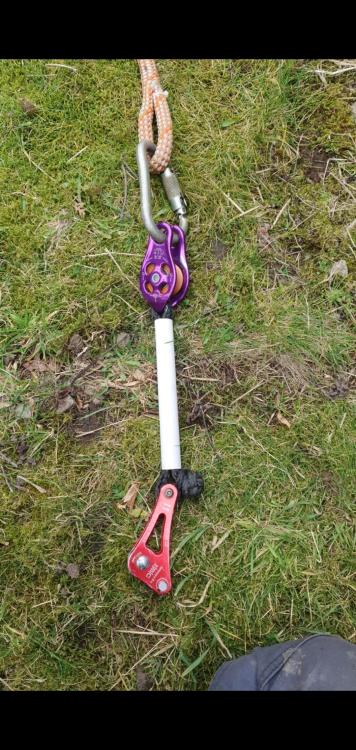
No just made one with my unused rope wrench.. It's very good and can be taken off the pinto easily if it's not required. It works very well with my harken with one groundy to lift branches away, then I can take control in the tree and lower it. At a guess it takes about 50% of the load meaning it's possible to lift 100-150kg branches on the harken and then release It off the harken to lower it by hand. I'd recommend giving it a go
-
One of these (DIY or an actual rigging wrench) is invaluable for rigging in the tree or working with only one grounds man as you can readily control it as they land it.
-
Cumbria had some excellent birch trees
-
In this country yes. In others no. It's an interesting topic, the UK is very much a about wrong tree in the wrong place. However if you visit Sweden or Canada there are much larger trees in higher numbers in proximity to building without issue. So perhaps it's more 'right tree wrong attitude'. I do understand that I am in the minority thinking like this in the UK. But I do find the differing views of what's considered as appropriate sized trees to proximity to buildings based on geographic location and social norms interesting.
-
From the TMA webpage: 'Associated with a selective white rot of the wood. Causes cavity formation. When found locally, decay is more likely restricted to this area. Multiple brackets over larger areas suggests widespread dysfunction. Associated with the decline of trees, when found in abundance. Associated with stem and limb failure – notably in species with weaker wood qualities (horse chestnut, poplar).' I'd suggest at present it's localised in the dysfunctional wood from where the fruiting body is emerging. Something to keep an eye on though as any significant decay at the base will increase likelihood of failure.
-
900mm! I reckon you need a more accurate tape measure.
-
Looks like it was a fine tree with the only defects being from poor work previously with to harsh a crown raising. The wound below the crown break isn't a concern currently, but seems freely used to sell a removal. The crown break all appears normal with unions that do not indicate any significant weakness. The reaction growth you mention at the crown break will likely have come as a response to excessive crown raising and the rasing of the central force of the wind as well as increasing the bending moment. Little else for it though if they want it smaller there is no longer much to reduce it to... so another one bites the dust and another contribution towards urban deforestation
-
I do not understand the customer not being willing to pay for a groundsman as a valid excuse for not having one. Curious of what you charged for thos job and what the difference would have been to have a ground man's?
-
It's a basic Box ticking certificate with some good information. (Not actually done it mind but have read the syllabus, spoke to people that have) Being mentored and time to practice is the only way to becoming good at rigging
-
Get your groundy to put the phone down and work the lines..
-
Just download the stihl app, it doesn't ask for any detaild
-
A flat wound that size ain't healing anyway. Either leave it as is or cut it in a way to harbour insects etc to give them somewhere to live. Flat tidy cuts are irreluvant when the thing will never occluded.
-
Presumably a more mellow taper on them being the thing there?