



Johnsond
-
Posts
10,514 -
Joined
-
Last visited
-
Days Won
118
Content Type
Profiles
Forums
Classifieds
Tip Site Directory
Blogs
Articles
News
Arborist Reviews
Arbtalk Knot Guide
Gallery
Store
Freelancers directory
Everything posted by Johnsond
-
😂😂 You need the site mystic

-
He !!! Or I !!!, well there are two people in the picture of the post preceding yours. You have just named them both 🤷♂️
-
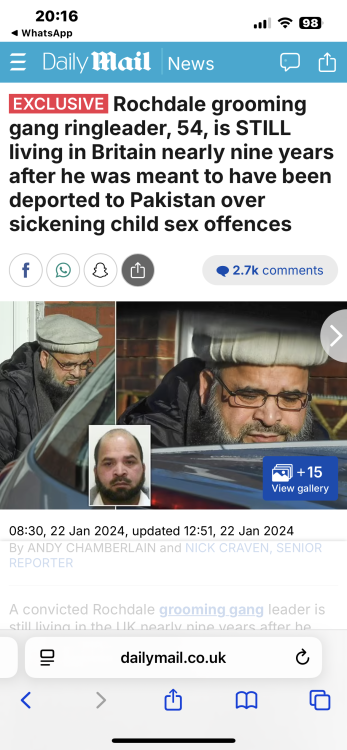
Pakistan won’t take him back 🤷♂️🤷♂️WTF A convicted Rochdale grooming gang leader is still living in the UK nearly nine years after he was ordered to be deported. In a case that shocked the nation, nine Asian men were convicted in 2012 of a range of sexual offences against children including rape, trafficking and conspiracy to engage in sexual activity with children in and around Rochdale, Greater Manchester. But the pair's removal has been delayed because Pakistan, is reportedly refusing to allow them to return. Both men claimed during their deportation appeals that they have renounced their Pakistani citizenships, rendering them 'stateless
-
Starmer 🤔no chance
-
Looks like Starmer had his arse handed to him by his boss, what a bunch of incompetent fools

-
100% I don’t think enough people even give a minute’s thought to the aftermath of these incidents, what those children, girls or woman went through or live with afterwards. Many are just way too busy throwing the racist accusation around to even care. SP/TA seems to have had a change of heart. Common sense maybe at last.
-
550c3474-2e94-4518-8cbd-691e17418388.mov
-
I’ve often wondered what the process was that allowed the authorities to turn a blind eye or ignore the industrial scale rape of children and young girls in the UK by predominantly Pakistani Muslim men. Dempsey has just provided a good example of what was in no small measure a big part of the problem.
-
I didn’t for one minute expect a straight honest answer from you. On the well worn racist accusation path, what is your experience of working overseas SP/TA, asked it before I knowbut hey you can only hope !! Your previous post contained zero facts or evidence as usual. Right on time looks like your beloved asylum seekers just can’t help themselves.

-
That’s very true but it still stands that certain ethnic groups are substantially more likely to be committing the offences, the tragic thing for the victims is certain people are more likely to be offended by someone pointing out the obvious rather than the by the actual offence.
-
And why do you think there’s a reluctance to record or disclose ethnicity Oldfeller??
-
In other words total made up BS That you can’t back up. Just for clarity are you saying that some nationalities in particular among those illegally entering the UK are not disproportionately more likely to commit sexual offences or rape than the the indigenous population ?? That’s a very simple question even for you.
-
Ah he who refuses to answer any questions comes to life with a bit of help 😂👍 Of course they don’t you daft bugger. Is that your Eureka moment ??? No one is desperate wee man, you can’t accept that statistics don’t lie on this one, there are certain ethnic groups whom are absolutely more likely to commit rape and sexual offences, you like other weak individuals care nothing for the victims. OK SP/TA educate everyone as to how or why we are all statistically challenged compared to you. Put up the facts or evidence of these “ mathematical types” try not to do your usual nonsense and just behave like nothing was asked. There’s a good leftard.
-
Good post “ you “ put up there “online” 42 👍
-
Indeed there will be and and if anyone thinks otherwise they are kidding themselves, if caught they deserve everything that comes to them. Hopefully the days of the authorities ignoring such cases in order to not upset a communities religious sensitivities are over. It’s also statistically less likely full stop to be a white guy compared to some nationalities.
-
Yeah with a bit of selective editing it’s no problem Few decent old pensioners with probably not a PHD between them. Some highly educated pro integration professionals 🤷♂️ peacefully making their point. Bit like a game of top trumps 😂



-
Families men women and children young and old. Strangely I’m often accused of racial/religious bias to a whole community too. I’m often told it’s only a few individuals not the majority “ some girl” as you put it being raped does tend to bring out the anger in a community 🤔

-
I’d say that’s very much not the case. The presumption that the lower class thick oiks just don’t “ get it” is the arrogance of the left on display at its most nauseating worst.
-
Research indicates that individuals employed in the private sector are more likely to hold right-wing, conservative, or market-liberal views compared to their public sector counterparts, who tend to lean towards left-wing parties . This divide is often associated with differences in economic security, views on taxation, and attitudes toward government regulation. Key findings on the relationship between the private sector and right-wing political leanings: Small Business Owners: Studies show that small business owners and those in the "gig economy" are significantly more likely to identify with right-wing parties. This is often due to a preference for lower taxes and fewer regulations. Industry Differences: Small business owners in sectors with high regulatory, labor, or compliance interfaces—such as construction, healthcare, and manufacturing—tend to lean Republican or right-wing. Company Size: Workers in smaller companies tend to be more conservative on socioeconomic issues and more skeptical of trade unions than those in large corporations, according to research from 16 European countries. Private Education Link: In the UK, individuals with a private school education are twice as likely to be consistent Conservative voters by midlife, and one and a half times more likely to hold right-wing opinions regarding income redistribution and the role of business. Voting Behavior: Private sector workers have long been more likely to vote for conservative parties (such as the Conservatives in the UK) compared to public sector workers. Drivers of Right-Wing Views in the Private Sector Reduced State Intervention: Private sector workers generally favor less state intervention in the economy. Economic Independence: The experience of running a business or being self-employed often leads to a preference for economic individualism over state-provided social safety nets. Cultural Factors: Some studies suggest that the "experience of being a small business owner" directly influences the adoption of conservative views on regulation. Those at the bottom of the education/ employment ladder are as often as not the ones most affected by mass immigration. The conclusion they are likely to be against it is not surprising nor requires a degree to make.
-
😂😂😂Ambiguity SP/TA you couldn’t lie straight in bed wee man. That is your high level strategic view of the situation I gather. Venezuela 🇻🇪 and Norway 🇳🇴 !!!!!! ??????
-
You don’t need or use a heavy lift vessel to repair jackets or platforms. You never mentioned onshore wind or solar in your op. But there’s a multitude of large crawler or mobile cranes in the UK configured for that kind of work by way 😞😞. What part of store Oil did you fail to comprehend ( Strategic oil reserve and Commachio company there’s something to sit in front of your coal fire and educate yourself with tonight) . SP/TA you are trying to sound knowledgeable about industries you have no knowledge or experience of and it shows big time. Solar and wind won’t cut it if the shit hits the fan, even the most green of green leftards gets that.
-
Well someone has to feed the TDS sufferers 42. Question Question Question Question 🤔🤔no thanks lad, been there done that too many times, I might try SP/TA’s tactics and just act as though you never asked any, you seem ok with that.
-
He’s not my emperor Mark Im a UK citizen lad, the democratic process of the USA is nothing to do with me, that’s you just making shit up again 🤷♂️ I’ve said this before you class anyone whom is not a TDS sufferer as a supporter. What is embarrassing is Starmers behaviour, Maggie had Reagan eating out of her hand back in the day.
-
@Mark J @Steven P We await with interest your response to the request from 42
-
How did I know it would be you SP/TA. Well you can store oil you can’t store electricity id have thought that was school boy simple stuff. Here again you show your total lack of subject knowledge I’m afraid, you don’t need to take out every turbine you daft bugger 😂😂😞all you need to do is take out the export cable or the offshore substation itself. You obviously don’t know but the UK ( despite people like you believing the world leader guff you read) does not own a single heavy lift vessel capable of installing or repairing the wind turbines and infrastructure around our coast. I’ve been telling you this for ages, obviously it’s not sinking in.